Authors: Akwila Temu1 (atemu@pedaids.org), Roland Van de Ven1, Monica Peter1, Joseph Matemba1, Lynette A. Faux During1, Webester Chanai1,
Barthazary Benedicto1, Landrada Mutasingwa1, Frank Lyimo1, Jacqueline Kalimunda1, Sajida J. Kimambo1
Author affiliation: 1Elizabeth Glaser Pediatric AIDS Foundation, Dar es Salaam, Tanzania
Background
Despite access to antiretroviral therapy (ART), mortality among children living with HIV (CLHIV) remains a challenge in high-burden settings. Mortality reviews conducted in Tanzania in 2024 identified children under five years of age, severe malnutrition, and tuberculosis (TB) as leading contributors to death.
We assessed the implementation of standardized pediatric mortality audits and associated programmatic responses on mortality trends among CLHIV in Tanzania.
Methods
We conducted a longitudinal analysis of routinely collected pediatric mortality audit data from HIV care & treatment services in Tanzania over four years (Oct 2021- Sept 2025), covering 456 facilities. Standardized facility-based mortality audits were conducted for all reported deaths among CLHIV (<15 years) receiving ART.
Multidisciplinary teams reviewed clinical records using standardized tools to assign causes of death by consensus and identify contributing client-, provider-, and system-level delays and gaps in care.
Findings informed implementation and scale-up of a child-centered care package, including WHO STOP AIDS (Screen, Test, Optimize, Prevent) interventions and routine nutritional assessment. Mortality trends were analyzed over time by age group and contributing cause.
Results
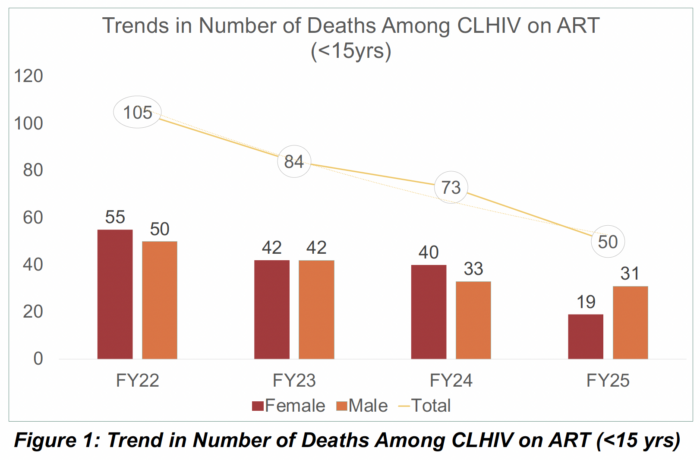
Between October 2021 and September 2025, pediatric deaths among CLHIV on ART declined by 52%, from 105 deaths annually in 2022 to 50 deaths in 2025. (Figure 1)
The death rate decreased from 18 to 9 children per 1,000 children on ART.
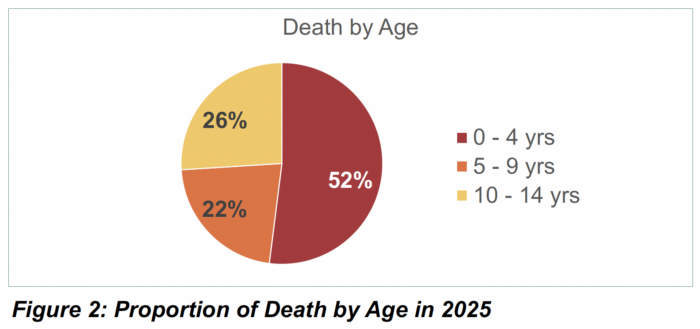
Children under five years accounted for 52% of deaths in 2025, compared to 68% in 2022 (Figure 2).
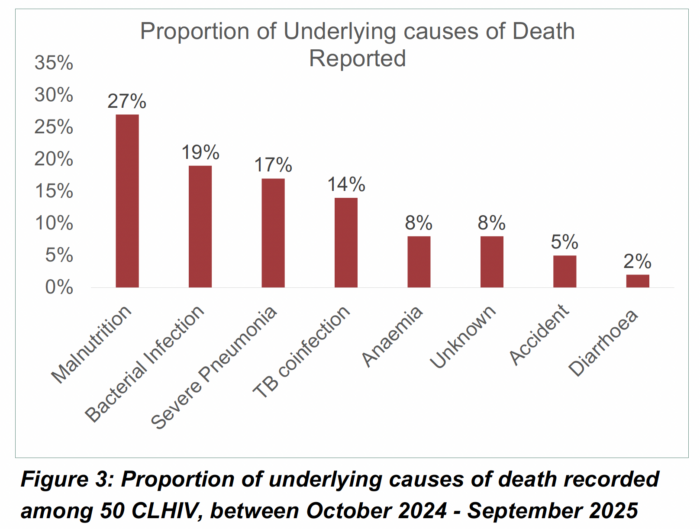
Severe malnutrition was the leading underlying cause of death in 2025 (27%), compared to (42%) in 2022, followed by bacterial infection (19%), severe pneumonia (17%), and TB (14%) (Figure 3).
Main Findings
52% reduction in pediatric death; death rate decreased from 18 to 9 per 1,000 children on ART.
Children under five years accounted for 52% of deaths in 2025.
Severe Malnutrition is the leading underlying cause of death in 2025 (27%).
Conclusions
Routine pediatric mortality audits were associated with a decline in reported deaths and provided actionable insights to guide quality improvement in HIV care.
Under-five mortality in CLHIV on ART remains high and is primarily driven by severe malnutrition and tuberculosis, highlighting that ART access alone is not sufficient.
Institutionalizing mortality audits alongside integrated nutrition and strengthened TB screening and management is essential to further reduce pediatric HIV mortality.
Acknowledgements
We acknowledge the contribution by the health care providers in the supported facilities and the Ministry of Health of Tanzania. This work was made possible by the support of the American people through the United States Department of State through the office of foreign Assistance. Under the Afya Yangu (My Health) Northern Activity, Contract No: 72062122C00001. The opinions expressed herein are those of the author(s) and do not necessarily reflect the views of the American government.
*This poster was presented at the 18th International Workshop on Pediatrics & HIV 2026 in Rio de Janeiro, Brazil