

Authors: Lucky Makonokaya1 , Louiser Upile Kalitera1, Eddie Matiya1, Pamela Gondwe1, Lloyd Chilikutali1, Bilaal Wilson Matola1, Thulani Maphosa1, Nilesh Bhatt2
Affiliations: 1Elizabeth Glaser Pediatric AIDS Foundation, Lilongwe, Malawi; 2Elizabeth Glaser Pediatric AIDS Foundation, Washington, D.C., United States
Background
Cryptococcal meningitis remains a major cause of HIV-related mortality among people with advanced HIV disease (AHD) in sub-Saharan Africa.
We assessed 24-month survival and factors associated with mortality among AHD clients with cryptococcal antigenemia enrolled in Malawi’s AHD program.
Methods
We conducted a retrospective cohort study using routine program data from 22 health facilities in central Malawi. All AHD clients with confirmed serum CrAg positivity enrolled between January 2021 and September 2024 were included.
Survival up to 24 months was estimated using Kaplan–Meier methods. Factors associated with mortality were assessed using Cox proportional hazards regression.
Results
102 patients included (127 person-years follow-up). Median age was 37 years, and 25.5% had TB co-infection.
Lumbar puncture was performed in 64.7%, among whom 30.3% were diagnosed with cryptococcal meningitis.
Overall mortality was 19.7 deaths per 100 person-years, with 75% of deaths occurring within the first six months. Estimated 24-month survival was 73%.
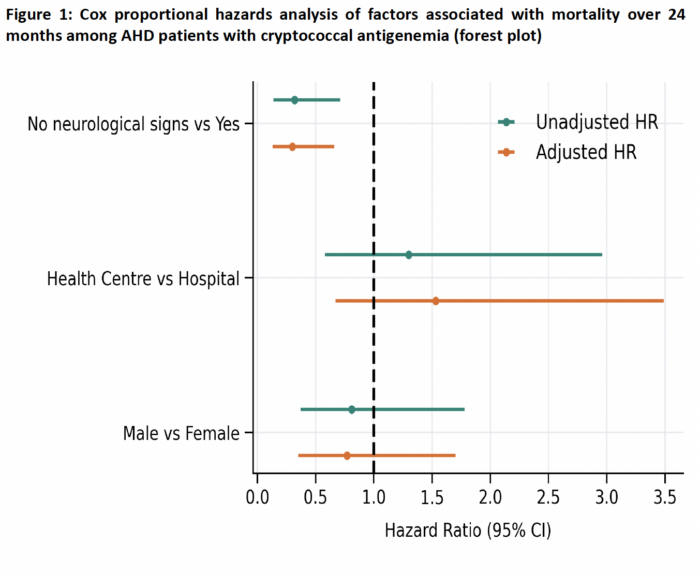
In multivariable analysis, absence of neurological signs at enrollment was independently associated with a significantly lower mortality risk (aHR 0.30, 95% CI 0.13-0.66).
Main Findings
Nearly three-quarters of CrAg-positive AHD clients survived to 24 months under routine program conditions, but early mortality remained high.
Absence of neurological signs was independently associated with a significantly lower mortality risk.
Conclusions
Twenty-four-month survival among patients with cryptococcal antigenemia in routine AHD programs was high; however, substantial early mortality was observed despite high fluconazole prophylaxis coverage.
Incomplete CM diagnostic evaluation and the strong prognostic value of neurological signs highlight missed opportunities for early risk stratification and appropriate management.
Strengthening access to lumbar puncture, prioritizing close early follow-up, and targeting patients with neurological symptoms may further reduce mortality within routine AHD programs.
Acknowledgements
The work described in this poster was supported by the Bill and Melinda Gates Foundation (BMGF). Its contents are solely the responsibility of the authors and do not necessarily represent the official views of the funder.
*This poster was presented at the 2026 International AIDS Conference in Rio de Janeiro, Brazil